When Texas homeowners start their solar journey, they face an immediate fork in the road: request quotes through a platform like EnergySage, where multiple installers bid for your business, or go direct to local solar companies and negotiate one-on-one. The choice sounds simple until you factor in ERCOT’s deregulated market, Texas’s fragmented utility landscape spanning CPS Energy in San Antonio, Oncor in North Texas, and AEP in West Texas, and the real clock-to-closing pressure that affects your final price. This article cuts through the noise and shows you exactly how each path works, what it costs, and which one makes sense for your Texas home.
The Texas Solar Quote Problem: Why Most Homeowners Choose Aggregators
Texas installed 6.1 GW of residential solar capacity in 2023, according to the Solar Energy Industries Association, marking an 18% year-over-year surge in homeowner adoption. That growth came with a problem: as installation markets grew, so did installer fragmentation. In Austin, you might find 500+ licensed installers. In Houston, fewer than 300. In rural West Texas and the Hill Country, networks thin out dramatically.
Here’s what most homeowners don’t realize: Texas’s split between ERCOT-regulated and utility-regulated territories creates a hidden complexity. Your interconnection timeline, rebate eligibility, and installer network all shift depending on which utility territory you’re in. A CPS Energy customer in San Antonio has access to entirely different incentive programs than an AEP customer in West Texas. Going direct to installers means you might discover halfway through the quoting process that a company you called doesn’t serve your exact utility zone.
Quote aggregators like EnergySage handle that friction. They pre-vet installers for licensing, service areas, and capability. The platform routes homeowners to qualified contractors in their specific region. For most Texas homeowners—especially those outside major urban centers—this saves dozens of cold calls and research hours.
What Is EnergySage? How the Platform Works
EnergySage operates as a marketplace connecting homeowners to installers. You enter your home’s address, roof characteristics, energy usage, and financing preferences. The platform’s algorithm filters its network of 5,000+ installers nationwide—roughly 750 to 1,000 active in Texas—and routes your inquiry to 3–5 companies that match your location, system size, and budget.
Installers respond within 1–3 business days with detailed quotes including system size (measured in kilowatts), equipment brands, installation timeline, and financing options. You see competing bids side-by-side. Energy production estimates differ slightly based on installer modeling; final pricing often varies 15–25% across three competing quotes for identical roof configurations. This transparency is EnergySage’s primary value: competitive pressure keeps installer pricing honest.
EnergySage reports that 70%+ of platform users receive multiple quotes. Average quote turnaround: 1–3 business days. You then negotiate directly with installers from your shortlist. Payment to installers comes through EnergySage (protecting your financial data through the platform) or direct contracts with selected companies.
Direct Solar Quotes: Control Over Convenience
The direct quote approach means you identify solar installers independently and contact them. Sources include: Google search (your city + “solar installer”), TDLR directory (Texas Department of Licensing and Regulation maintains a searchable database of all licensed contractors), local solar advocacy groups, and neighborhood recommendations.
Direct outreach typically takes longer. Expect 5–10 business days for initial proposals, assuming you reach qualified installers with capacity. You’ll also receive fewer competitive bids—perhaps 1–3 instead of EnergySage’s standard 3–5. Why? Because installers you cold-call have no obligation to compete for you. They manage their own sales pipeline and often prioritize warm leads or existing customer referrals.
The advantage: direct quotes let you negotiate with installers you’ve personally vetted. You control which companies see your information. You avoid platform fees (EnergySage charges installers $25–$50 per qualified lead routed to Texas, a cost that sometimes flows back to homeowner pricing). You can also work with small, local shops that may not be on national platforms.
Price Comparison: Aggregator vs. Direct Lead Conversions
Here’s the financial reality: EnergySage and direct quotes often converge on similar final pricing. Why? Because the Texas solar market is increasingly competitive. Installers know national pricing benchmarks. They understand that customers shopping on EnergySage are also getting multiple bids. Whether you found them through a platform or cold-called them directly, they price competitively or lose the deal.
The difference shows up in effort, not price:
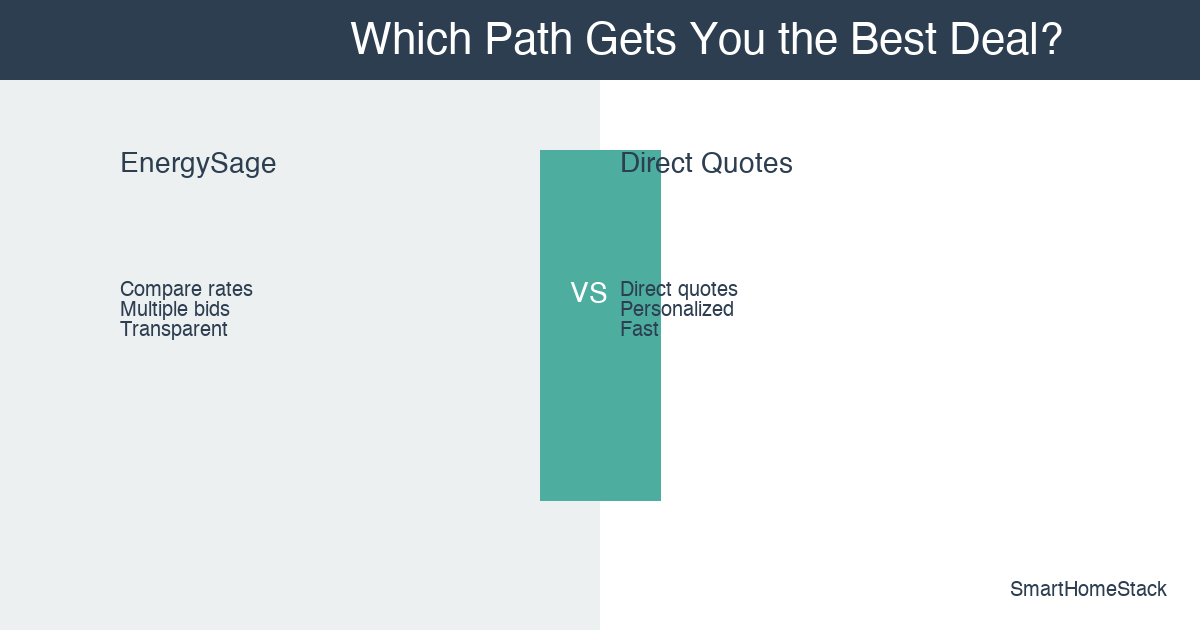
- EnergySage path: 1–3 hours of setup time; 1–3 business days to receive 3–5 quotes; 15–25% price variance across bidders (installer competition); financing pre-vetted by platform.
- Direct quote path: 5–10 hours of research (finding, vetting, cold-calling installers); 5–10 business days for 1–3 proposals; 5–15% price variance (less competition); you vet financing and licensing independently.
For the typical Texas homeowner, aggregator pricing is either equal to or 2–5% lower than direct quotes, after accounting for time cost. For homeowners in rural areas with thin installer networks, EnergySage’s price advantage is closer to 5–10%, because the platform can still route you to qualified companies that direct searching would miss.
Texas-Specific Considerations: ERCOT, Utilities & Lead Routing
Texas’s utility map complicates both paths. ERCOT territories (including Austin, Dallas, and Houston) are deregulated and have different interconnection timelines than CPS Energy (San Antonio), AEP (West Texas), or Oncor (North Texas regulated zone). Interconnection can take 2–4 weeks in ERCOT regions, 4–8 weeks in regulated utility zones.
EnergySage’s platform handles this complexity automatically. When you enter your address, the system identifies your utility and ensures routed installers serve that territory. Direct quote research requires you to manually verify service areas—a step many homeowners skip, then discover mid-quoting that an installer doesn’t serve their exact address.
Federal and Texas incentives (30% federal ITC, city/county rebates, utility rebates) are navigated similarly through both channels. However, EnergySage provides centralized rebate guidance; direct installers vary in their rebate knowledge. CPS Energy San Antonio customers, for example, benefit from utility-specific rebates that a regional installer may or may not highlight.
One critical step for both paths: verify your installer’s TDLR license at tdlr.texas.gov before signing any agreement. EnergySage pre-vets licensing; direct quotes require your verification. A licensed installer is non-negotiable—unlicensed work voids warranties and creates legal liability.
Which Approach Is Right for You?
Choose EnergySage if: You value speed and competitive pressure. You’re in a region with fragmented installer networks (outside Austin/Houston/Dallas metro areas). You want to compare multiple quotes in one place. You prefer letting a platform handle utility zone complexity. You’re willing to trade convenience for a small lead-generation commission that supports the platform.
Choose direct quotes if: You’ve already identified specific installers you trust. You want complete control over which companies see your information. You’re working with a small, local shop unlikely to be on national platforms. You prefer negotiating one-on-one. You have time to research and vet companies independently.
For most Texas homeowners, EnergySage represents the faster path to final decision. Average timeline: 2–3 weeks from quote request to signed contract. Direct approach: 4–5 weeks. The price difference is negligible; the time difference is real.
If you’re ready to move forward, compare free solar quotes through EnergySage—enter your address, review competitive bids from Texas installers, and negotiate with your top choice. The platform’s transparent pricing and installer vetting eliminate most of the legwork. Always verify your installer’s TDLR license before signing, and confirm rebate eligibility with your local utility or a tax professional. That discipline, combined with competitive bidding, is how Texas homeowners secure the best solar deal.
Quick Reference: EnergySage vs. Direct Quote Comparison
| Factor | EnergySage (Aggregator) | Direct Quotes |
|---|---|---|
| Quote Turnaround | 1–3 business days | 5–10 business days |
| Number of Bids | 3–5 competitive quotes | 1–3 proposals |
| Price Variance | 15–25% across bidders | 5–15% (less competition) |
| Time Investment | 1–3 hours setup | 5–10 hours research |
| Utility Vetting | Platform-verified | Your responsibility |
| TDLR Verification | Pre-vetted; confirm independently | Your responsibility |
| Final Price Premium | Neutral to 2–5% lower | Baseline (if direct-sourced) |
SmartHomeStack is an independent publisher. We are not a solar installer, solar retailer, or utility company. We earn referral fees when readers request quotes through links on this site. All content in this article reflects our honest analysis; we recommend products and services we’d genuinely consider for our own homes. Always verify your installer’s TDLR license and confirm tax credit eligibility with a licensed professional before making purchasing decisions.
Affiliate disclosure: SmartHomeStack earns commissions from qualifying purchases and referrals. This does not influence our editorial recommendations. Learn more.